TL;DR: Runner’s knee is a tracking problem, not a knee injury. The kneecap gets pulled off center by tight lateral muscles and weak hip stabilizers, and the pain follows. Acupuncture releases the structures doing the pulling, which relieves pain quickly and buys you a window to rebuild the strength that caused it. Needling alone won’t fix it. Needling plus targeted strength work will.
Acupuncture reduces runner’s knee pain by releasing the muscles that pull your kneecap out of its groove, mainly the vastus lateralis, the IT band and the tensor fasciae latae feeding into it. Most patients feel a meaningful difference within two to four sessions. What it doesn’t do on its own is fix the weakness that let the problem develop.
That last part is where most treatment for this condition goes wrong, and it’s worth being blunt about it. Runner’s knee comes back for the majority of people who treat only the painful area. The research on needling for patellofemoral pain is genuinely mixed for exactly this reason: needling as a standalone intervention doesn’t outperform good rehab, but it’s very good at doing something rehab can’t do quickly. Below we’ll explain what’s actually happening at your kneecap, which muscles we target, what the evidence supports, and how to keep it from returning.
What Is Runner’s Knee and Why Does It Hurt?
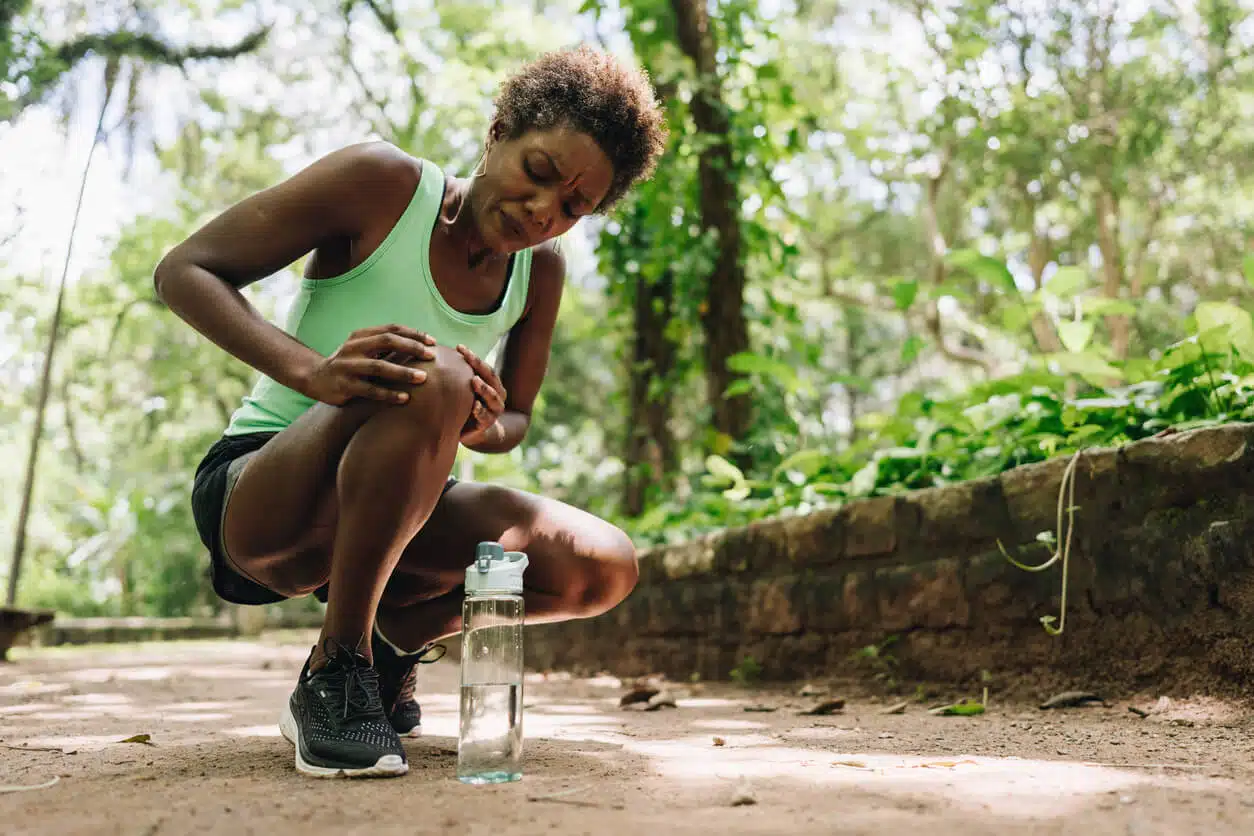
Runner’s knee, or patellofemoral pain syndrome, is pain around or behind the kneecap caused by the patella not tracking cleanly in its groove at the end of the femur. Instead of gliding straight, it drifts slightly outward, which concentrates load on one side of the joint surface. The pain is usually a dull ache that worsens on stairs, hills, and after sitting with bent knees.
Your kneecap sits in a shallow channel and is held centered by opposing pulls. The vastus lateralis on the outside of your thigh pulls it laterally. The vastus medialis, the teardrop-shaped muscle just above the inside of your knee, pulls it back toward the middle.
When the outside structures get tight and the inside ones get weak or delayed, the balance tips. A few millimeters of drift is enough to concentrate pressure and irritate the tissue behind the kneecap over thousands of running strides.
There’s a second contributor further up. If your gluteus medius isn’t controlling your hip, your femur rotates inward during stance. The kneecap doesn’t move relative to the femur in that case, but the femur moves under the kneecap, which produces the same tracking problem from the other direction.
Which Muscles Do We Target for Runner’s Knee?
We needle four regions in most cases: the vastus lateralis along the outside of the thigh, the tensor fasciae latae at the front of the hip, the gluteus medius at the side of the hip, and the vastus medialis just above the inner knee. Which ones get priority depends entirely on what tests weak or overactive during assessment.
The vastus lateralis is usually the loudest. In runners it’s typically thick, tight, and full of trigger points that refer pain directly into the front of the knee. Releasing it reduces the lateral pull on the patella immediately, and patients often notice the difference walking out of the office. Our notes on treating the outer quadriceps cover the referral patterns.
The tensor fasciae latae is small, sits at the front of the hip, and feeds into the IT band. When it’s overworking, it tightens the entire lateral chain down to the knee. Runners who also get outer knee pain often have both problems from one source, which we address in our piece on IT band syndrome.
The vastus medialis is the opposite problem. It’s usually inhibited rather than tight, meaning the nervous system has turned down its activation. Needling its motor point can restore that activation, which is the mechanism our overview of vastus medialis dysfunction gets into.
The rectus femoris deserves a mention too, since it crosses both the hip and the knee and gets short in anyone who sits a lot. We cover it separately in our article on rectus femoris tightness.
Does Acupuncture Actually Work for Patellofemoral Pain?
The evidence is mixed, and the pattern in it is instructive. Several trials show needling reduces pain and improves function in the short term. A 2017 trial in JOSPT found that adding three sessions of dry needling to a manual therapy and exercise program produced no additional benefit over the exercise program alone.
We think that result is being read backwards by both camps. It doesn’t show needling is useless. It shows that when someone is already doing correct, progressive strength work, needling adds less than you’d hope, because the strength work is doing the heavy lifting.
The clinical reality is that most people with runner’s knee are not doing correct progressive strength work. They’re doing quad stretches, foam rolling, and hoping. For that population, needling changes the picture substantially, because it reduces pain enough to actually load the joint and start training the muscles that need it.
That’s how we frame it with patients. Needling is the thing that opens the window. Strength work is what walks through it. Do one without the other and you’ll be back here in four months.
Why Runner’s Knee Keeps Coming Back
It returns because the pain resolves faster than the weakness does. Two or three weeks of reduced mileage plus some treatment will usually calm the joint down. The hip and quad deficits that caused the tracking problem take eight to twelve weeks to change meaningfully, and almost nobody keeps training that long once the pain is gone.
This is where our strength assessment does most of its work. Testing hip abduction, hip external rotation, and quad activation side to side tells us which muscles are actually underperforming, not which ones feel tight. Those are frequently different muscles.
We see the same finding constantly: pain on the right knee, weakness in the right gluteus medius, and a patient who has been diligently stretching their right quad for two months. Stretching a muscle that’s tight because it’s compensating for a weak one makes the compensation worse. Our article on gluteus medius dysfunction explains why the hip drives so much knee pain.
Training errors compound it. Sudden mileage increases, a jump into hill work, worn shoes, and a rapid switch to a lower drop shoe all show up in our office as knee pain three weeks later.
Is It Really Runner’s Knee?
Not always, and the distinction changes treatment. Pain directly on the tendon below the kneecap, tender to press and worse with jumping, is patellar tendinopathy rather than a tracking problem. Sharp pain on the outer knee that appears at a predictable point in every run is usually IT band syndrome. Pain with locking, catching, or true swelling suggests something inside the joint that needs imaging.
Runner’s knee itself is fairly recognizable: a diffuse ache you can’t point to with one finger, worse going down stairs than up, and worse after sitting with knees bent for a while.
We check for these distinctions at the first visit because treating a tendinopathy like a tracking problem wastes everyone’s time. Tendon problems need progressive loading more than they need release work. Our notes on needling for patellar tendon pain cover that separate protocol.
Swelling is the sign that should send you for imaging. Patellofemoral pain doesn’t typically produce a visibly swollen knee.
What a Treatment Course Looks Like
Expect six to eight sessions over six to eight weeks, usually weekly. The first two or three focus on reducing pain by releasing the lateral structures. From there we shift toward restoring activation in the muscles that tested weak, and we add corrective exercise you’ll do between visits.
Most runners can keep running through this at reduced volume. We’ll usually cut mileage by a third, pull out hills and speed work temporarily, and keep everything at a pain level of three out of ten or below during and after.
Complete rest is rarely the answer. Tendon and joint tissue adapt to load, and taking all load away means starting from a worse baseline when you return.
By week six we reassess strength. If the numbers have moved and the pain is gone, we transition you to a maintenance program and build mileage back at about ten percent per week. If the numbers haven’t moved, the exercise prescription needs to change, and that’s a more useful conversation than more needling.
The Bottom Line
Runner’s knee is a tracking problem driven by a tight lateral chain and weak hip stabilizers. Acupuncture is effective at releasing the structures pulling your kneecap off center, and that relief comes fast. What it can’t do is rebuild the strength that prevents recurrence, which is why we treat and train at the same time rather than one after the other.
If your knee pain keeps returning every time you build mileage back, the problem isn’t your knee. At LycoAcu, we test before we needle. Learn about our approach to sports therapy, strength assessment, and orthopedic acupuncture, or reach out to get assessed before your next training block.