TL;DR: Cupping uses suction to lift and separate the layers of tissue in your back, which reduces tightness and increases local blood flow. Research supports it for chronic low back pain, with effects that hold better than medication in several trials. It works best on broad, achy, stiff back pain rather than sharp nerve pain, and most people need four to six sessions.
Cupping helps back pain by decompressing tissue. Where massage and needling push in, cupping pulls up, separating the muscle from the layers of fascia stuck to it and drawing blood into an area that’s been chronically tight. For broad, aching, stiff low back pain, it’s one of the most efficient tools we have.
What most articles skip is the part that determines whether it works for you: cupping is a soft tissue treatment, so it helps back pain caused by soft tissue and does very little for back pain caused by something else. A disc pressing on a nerve root doesn’t care how much suction we apply. Below we’ll cover the mechanism, what the research shows, which back pain presentations respond, how many sessions to expect, and what the marks actually mean.
How Does Cupping Actually Relieve Back Pain?
Suction lifts the skin and superficial fascia away from the muscle underneath. That does three measurable things: it separates tissue layers that have adhered to each other, it pulls fresh blood into the area, and it stimulates the nerve endings in the fascia in a way that reduces the pain signal from that region.
The fascia part matters more than people realize. Your back muscles are wrapped in connective tissue that’s supposed to glide. When an area has been guarded or immobile for months, those layers get sticky and stop sliding past each other. That restriction alone produces stiffness and pain even when the muscle itself is healthy.
Manual work can address this, but hands compress tissue. Cups decompress it, which reaches the adhesion from the opposite direction. It’s why cupping often produces relief in areas that felt unchanged after months of massage.
The circulation effect is visible. The discoloration that appears under a cup is blood drawn into the superficial tissue, bringing oxygen into a region that had poor flow. That’s also why the marks appear darkest exactly where the tissue was most restricted.
What Does the Research Say About Cupping for Low Back Pain?
The evidence is reasonably strong for chronic low back pain. A 2024 systematic review and meta-analysis of eleven randomized trials found moderate-to-high quality evidence that cupping improves both pain and disability, with effects that outperformed medication and usual care and that persisted at follow-up.
That said, the same review flagged real limitations, and we’d rather tell you than oversell. Study protocols vary widely in session count, cup type, and placement, which makes the results harder to pin down. Broader evidence maps rate the overall quality as low to moderate rather than definitive.
So the honest summary is this: cupping performs well against the alternatives it’s usually compared to, the effect holds for at least a couple of weeks, and the research base is decent without being airtight. For a treatment with a very low risk profile, that’s a favorable trade.
We’d add one clinical observation the studies don’t capture well. In our experience, cupping works best as part of a treatment rather than as the whole treatment. Combining it with needling and corrective exercise produces results that neither approach reaches alone.
Which Kinds of Back Pain Respond Best?
Cupping works best on back pain that feels broad, achy, stiff, and worse after sitting or standing in one position. If you’d describe the area as tight, heavy, or like it needs to be stretched but stretching doesn’t touch it, that’s the profile we see respond most reliably.
Specific presentations that tend to do well:
- Chronic low back tightness with no clear injury behind it
- Postural back pain from desk work or driving
- Muscle guarding after a strain has healed but the tightness stayed
- Broad mid-back and rib cage stiffness
- Quadratus lumborum tightness, which produces a deep one-sided ache just above the hip
That last one is worth naming because it gets missed constantly. The QL sits deep and refers pain in a pattern people mistake for a disc problem or a hip issue. We’ve written separately about treating the quadratus lumborum directly, and cupping over the region complements that work well.
What responds less well: sharp pain with a specific movement, pain that shoots down a leg, numbness or tingling in the foot, and pain that’s worse at night regardless of position. Those point toward nerve or joint involvement, and they need a different plan. Our article on conservative care for disc-related back pain covers that territory.
Fixed Cupping or Moving Cupping?
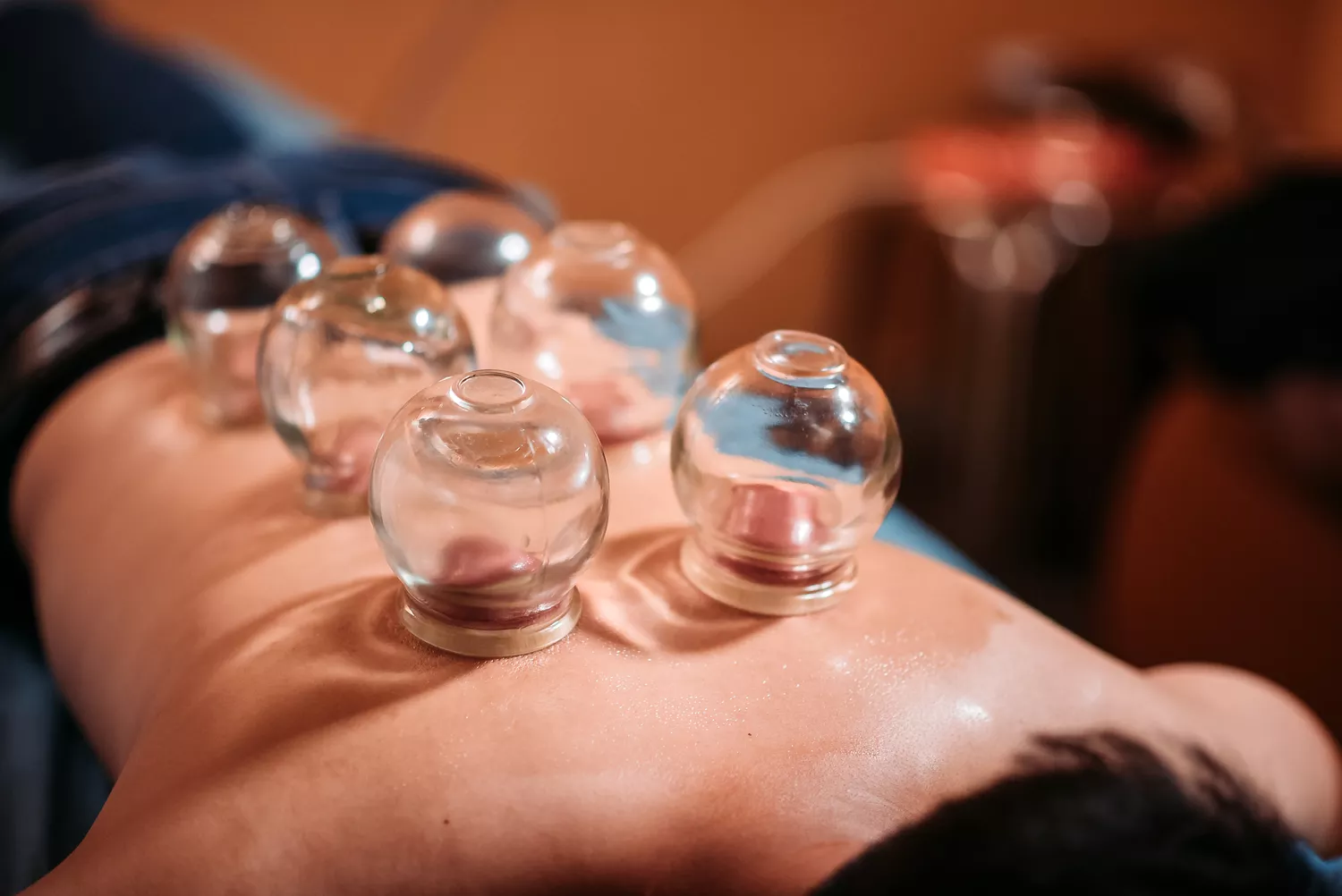
We use two techniques, and they do different jobs. Fixed cupping leaves cups in place for five to fifteen minutes over specific tight areas, which produces deeper local decompression and stronger marks. Moving cupping glides an oiled cup across the back, covering a wider area with less intensity and rarely leaving much discoloration.
For a focused knot in the low back, fixed placement is the better tool. For general stiffness across the whole lumbar region or along the spine, gliding covers more ground and feels more like a massage.
Most sessions use both. We’ll glide first to warm the tissue and find the restricted areas, then park cups on whatever felt stuck.
There’s also wet cupping, which involves small skin incisions. We don’t use it for musculoskeletal back pain, and the research doesn’t show a clear advantage over dry cupping for this application.
What the Marks Mean and How Long They Last
The circular marks are not bruises. A bruise comes from impact damaging tissue. Cupping marks are blood drawn into the superficial layer by suction, without the tissue trauma. They’re painless to the touch, unlike a real bruise.
Color tells us something. Light pink or barely visible marks usually mean healthy, well-circulated tissue. Deep red or purple marks tend to appear over areas with significant restriction and poor blood flow. Patients often notice their marks get lighter over a course of treatment as the tissue improves.
Marks typically fade in three to seven days. First sessions produce the darkest ones. If you have an event coming up, tell us and we’ll use lighter suction or shorter hold times.
We go deeper into the color question in our piece on what cupping marks are telling you, which is the question we field more than any other.
How Many Sessions Will You Need?
Most patients with chronic low back pain need four to six sessions before we can judge whether the approach is working. You’ll usually feel looser immediately after the first one, but that initial relief often fades within a day or two. Lasting change tends to show up around the third or fourth visit.
Weekly spacing works for most people. Twice weekly is reasonable for the first two weeks if the pain is significant, then back to weekly.
If nothing has changed by the fifth or sixth session, that’s meaningful information. It usually means the soft tissue wasn’t the primary driver, and we’ll widen the assessment rather than book you for six more.
We rarely use cupping alone. Pairing it with needling addresses the deeper muscles that suction can’t reach, and our notes on needling for chronic low back pain explain how the two fit together. For athletes managing training load alongside back tightness, our overview of cupping in a recovery routine covers scheduling around hard sessions.
Practical Details Worth Knowing
Cupping is comfortable for most people. The sensation is a strong pulling or tugging, sometimes intense but not sharp. Tell us if any cup feels too strong and we’ll release the suction immediately.
Afterward, keep the area warm and covered for a few hours, drink water, and skip the sauna or a hot tub that day. Light movement is good. A hard training session is better saved for tomorrow.
A few people should avoid cupping or need modifications: anyone on blood thinners, with a bleeding disorder, with skin conditions or open wounds in the treatment area, or in the first trimester of pregnancy. We also work around recent surgical sites and areas with poor sensation.
For patients whose restriction sits deeper than suction can reach, instrument-assisted work is often the better fit. Our description of instrument-assisted soft tissue techniques explains where that line falls.
The Bottom Line
Cupping earns its place in back pain treatment when the problem is soft tissue: broad stiffness, chronic tightness, and fascia that stopped gliding. The research supports it for chronic low back pain, the risk profile is low, and most people know within four to six sessions whether it’s working. It’s not the answer for nerve pain, and any honest practitioner will tell you that.
If your back has been tight for months and stretching hasn’t touched it, that’s the pattern this treatment was built for. At Lycoming Orthopedic & Sports Acupuncture, we assess before we treat. Learn about our approach to cupping, soft tissue mobilization, and pain management, or get in touch to talk through what’s going on.